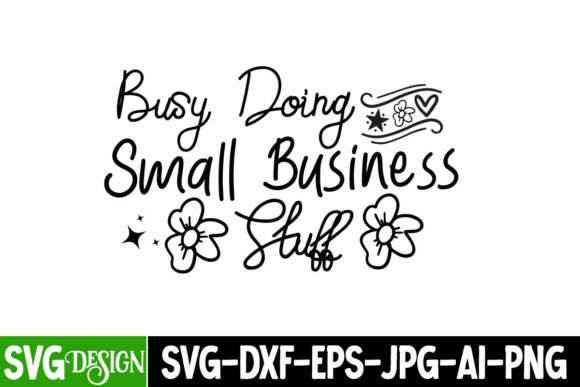
Busy Doing Small Business Stuff SVG: A Strategic Tool for Branding, Communication, and Creative Workflow
When you run a small business, every asset you create either moves your brand forward or adds noise. The Busy Doing Small Business Stuff SVG and Word By Layer Cut File is a digital download designed for entrepreneurs, freelancers, and content creators who want to communicate the reality of running a business—without sacrificing design quality. This file package includes six formats: SVG, EPS, PNG, DXF, Ai, and JPEG, giving you flexibility across platforms like Cricut, Silhouette, Inkscape, Adobe Photoshop, and Adobe Illustrator. But beyond the technical specs, this asset raises a more important question: how do you use a design like this intentionally, in a way that supports your goals rather than just filling space?
This article explores what the Busy Doing Small Business Stuff SVG actually offers, how thoughtful use of it can support your branding, communication, and productivity, and what to consider before adding it to your workflow. Whether you are a solo operator, a professional building a side project, or a marketer shaping a brand voice, understanding when and why to use a design asset matters more than having it in your library.
What the Busy Doing Small Business Stuff SVG Package Contains and Why It Matters
The package is a single ZIP file containing six layered files, each serving a different production purpose. The SVG layered file is the core design, built for cutting machines and scalable vector editing. The EPS file provides a high-quality vector option for professional printing. The PNG is print-ready, the DXF works with AutoCAD and similar interchange tools, the Ai file is the Adobe Illustrator source, and the JPEG offers a high-resolution raster version.
Having multiple formats means you are not locked into one tool. If you design on a Mac with Illustrator but your production partner uses a PC with AutoCAD, the DXF file bridges that gap. If you need to quickly upload a design to a print-on-demand shop, the PNG or JPEG works. The layered SVG is especially useful for those who use cutting machines—you can separate elements, resize them, and apply different materials to each layer. For a small business owner, this reduces the time spent converting files and lets you move from concept to finished product faster.
Strategically, this multi-format approach aligns with a principle every decision-maker should consider: reduce friction before you scale. By having one asset that works across multiple environments, you avoid the hidden cost of reformatting, re-exporting, or re-creating designs. That saved time can go toward higher-value work—customer outreach, product development, or refining your brand message.
Using the Design to Reinforce Your Brand Identity and Positioning
The phrase "Busy Doing Small Business Stuff" is more than a caption. It is a positioning statement. It tells your audience that you are active, hands-on, and deeply involved in the daily work of running a business. For many small business owners, this resonates because it reflects the reality of juggling operations, marketing, customer service, and product creation all at once.
When you use this SVG on merchandise, social media graphics, or physical products like stickers and tote bags, you are communicating a specific identity. You are not trying to appear like a large corporation. You are leaning into the authenticity of being small. That can be a strategic advantage. In a market where consumers increasingly value transparency and human connection, a straightforward message about being busy with real business tasks can build trust faster than a polished but generic slogan.
However, positioning requires context. Before you put this design on a product or a post, ask yourself: Does this message align with the experience I want my customers to have? If your brand is built around calm, premium service, a message about being busy might feel contradictory. If your brand is about hustle, transparency, and the realities of entrepreneurship, it fits naturally. The asset is a tool for reinforcing an existing identity, not a substitute for one.
Planning Your Use of the SVG for Maximum Creative and Operational Value
Rather than downloading the file and using it randomly, think of it as part of a broader creative workflow. Start by identifying where your audience actually encounters your brand. If you sell physical products, the SVG and DXF files can be used to create decals, labels, or custom packaging. If you operate primarily online, the PNG and JPEG versions can be used for social media posts, email headers, or blog graphics.
Consider creating a small collection of items that all feature the same design. For example, a sticker sheet, a notebook cover, and a digital wallpaper for your social channels. When people see the same design across multiple touchpoints, it reinforces recognition. This is a low-cost way to build brand consistency without needing a full rebrand.
Another planning consideration is production timing. Cutting machines and print runs take time. If you plan to use the SVG for a product launch, build in lead time for test cuts, material sourcing, and quality checks. The layered file structure lets you tweak colors and sizing, which is useful for custom orders or limited editions. But that flexibility also means you need to decide on specifications early—changing materials or dimensions late in the process can erode your margin.
How This Asset Can Support Customer Experience and Communication
Customer experience is not just about how you deliver a product. It is also about the signals you send before, during, and after a transaction. Using a design like Busy Doing Small Business Stuff can subtly communicate that you are a real person running a real business. That can make customers more patient during delays, more forgiving of small imperfections, and more likely to share your content because they feel connected to your story.
For example, a small bakery could use the SVG on a sticker placed on every box, with a handwritten thank-you note. A freelance web designer could use it as a laptop skin during video calls, signaling that they are hands-on and approachable. A content creator could use it as a backdrop in a video about daily routines. In each case, the asset becomes a communication tool, not just decoration.
On the digital side, the high-resolution JPEG can be used in email signatures, slide decks, or as a watermark on portfolio images. The EPS file can be scaled for large-format posters or banners without losing quality, which is useful if you attend trade shows or local markets. The key is to match the format to the medium, and the medium to the moment you want to create with your audience.
Practical Examples of Intentional Use in Different Business Contexts
Let us look at three realistic scenarios where this asset can serve a strategic purpose.
Scenario One: A Solo Service Provider Building a Personal Brand
A virtual assistant or consultant wants to create a small line of merchandise for networking events and client gifts. Using the SVG layered file, they design a series of stickers and a simple tote bag. The message "Busy Doing Small Business Stuff" aligns with their day-to-day reality and starts conversations at events. The PNG version is used as a header image on their LinkedIn profile. Over time, the design becomes a recognizable element of their personal brand.
Scenario Two: A Small Retail Shop Creating In-Store Signage
A local boutique owner uses the EPS file to print a small sign that sits near the register. It reminds customers that the shop is independently owned and operated. The same design is printed on packaging inserts using the DXF file for cutting a consistent shape. Customers associate the message with the experience of shopping locally, which reinforces loyalty.
Scenario Three: A Content Creator Producing a Limited Product Drop
A YouTuber or blogger who covers business topics decides to create a limited run of hoodies and mugs featuring the design. They use the Ai file to adjust colors to match their brand palette, then send the EPS to a print-on-demand partner. The JPEG is used for promotional posts on social media. The drop sells out because the audience already identifies with the message.
In each scenario, the asset is used deliberately. It is not a random decoration. It supports a specific goal—networking, customer connection, or limited-edition sales—and the format choice follows from that goal.
Risks of Using the SVG Without Clear Goals or Context
Any design asset can become a liability if it is used without thought. The most common risk is brand misalignment. If your business positions itself as high-end, minimalist, or luxury-focused, a casual message about being busy may undercut that perception. Customers may see it as unprofessional or out of step with your usual tone.
Another risk is overexposure. If you put the same design on every surface—your website, your products, your social media, your email—it can feel repetitive rather than recognizable. The novelty wears off, and the message loses its impact. Rotating designs or using this asset only for specific campaigns helps maintain its freshness.
There is also a practical risk around file handling. The ZIP contains multiple formats, and not every user knows which one to use for their specific machine or software. Using the wrong format can result in cut errors, poor print quality, or wasted material. Before you start a production run, test the file on a small batch. Confirm that the layers are properly named, the sizing matches your intent, and the colors render correctly on your chosen substrate.
How to Approach the Busy Doing Small Business Stuff SVG Intentionally
Intention starts with a simple question: What do I want this design to do for my business? If the answer is "I just like it," that is fine for personal use, but for business use, you want more clarity. Maybe you want it to spark conversations at events. Maybe you want it to make customers smile. Maybe you want it to reinforce that you are a real person, not a faceless brand. Write that goal down, and let it guide your decisions about format, placement, and frequency.
Next, decide on a limited set of applications. Choose two or three places where the design will appear, and commit to those for a specific period—say, three months. After that, evaluate whether the design helped achieve your goal. Did people mention it? Did it increase engagement on a particular platform? Did customers respond positively? That feedback will tell you whether to expand its use or retire it.
Finally, keep the original files organized. The ZIP includes six formats. Store them in a cloud folder with clear naming conventions. If you ever need to recreate a product or update the design, having the source files accessible saves hours of searching and reformatting. This is a small operational discipline that pays off quickly when you are busy—doing small business stuff, as it happens.
Long-Term Value: Why This Asset Belongs in Your Creative Library
Over time, the value of a design asset is not in any single use but in how it helps you maintain consistency and speed. The Busy Doing Small Business Stuff SVG gives you a ready-to-use design that you can adapt across seasons, campaigns, and product lines. Because it comes in multiple vector and raster formats, it is future-proof for new tools or production partners you may work with later.
For entrepreneurs and small business owners, time is the scarcest resource. Having a file that works out of the box—without needing to recreate or re-purchase—means you can focus on the decisions that matter: what to make, when to offer it, and how to talk about it. That is the real return on investment from a digital download. Not just the design itself, but the hours it saves you and the clarity it brings to your creative workflow.
Whether you use it for merchandise, marketing, or personal branding, the key is to treat it as a strategic tool, not a random graphic. Plan where it fits, test it in the real world, and let your audience tell you if it resonates. That approach turns a simple SVG file into a genuine business asset.