Mastering Creative Skills: A Deep Dive into How to Draw Easter for Kids Vol-3
Building artistic confidence in children often begins with structured, seasonal activities that feel both playful and achievable. How to Draw Easter for Kids Vol-3 is designed to bridge the gap between simple doodling and intentional drawing practice, offering a complete framework for young learners during the Easter season. This volume is more than just a collection of sketches—it is a carefully compiled resource that integrates developmental drawing techniques with festive themes, making it a valuable tool for parents, educators, and content creators alike.
What Makes This Volume Distinct for Young Artists
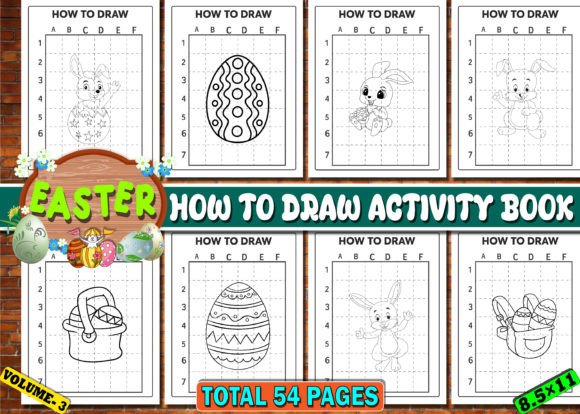
The third volume in this series focuses on progressive skill-building through Easter-centric imagery. Unlike generic drawing books, this edition leans into the rich visual language of springtime celebrations: bunnies, decorated eggs, chicks, baskets, and floral motifs. Each page presents a step-by-step breakdown that encourages children to observe shapes, practice line control, and build sequences without feeling overwhelmed. The structure is intentionally loose enough to allow for creative variation while providing enough guidance to prevent frustration.
For educators and homeschoolers, the progression from basic outlines to more detailed compositions mirrors established pedagogical approaches in early childhood art education. The 54-page count is not arbitrary—it offers enough material for a full month of daily drawing activities, which aligns well with classroom planning or Easter break enrichment programs.
Understanding the KDP Interior Advantage
For self-publishers and small business owners exploring the Amazon Kindle Direct Publishing platform, How to Draw Easter for Kids Vol-3 arrives as a fully tested interior solution. The .zip file contains every format necessary for listing: AI, EPS, PDF, PNG, and JPG at 300 DPI resolution. This eliminates the common headache of converting files or troubleshooting print compatibility. The black-and-white format is deliberate—it keeps printing costs low for consumers while ensuring that the step-by-step instructions remain crisp and easy to follow on standard printers.
Dimensions of 8.5” x 11” are standard for KDP paperbacks, meaning your listing will meet Amazon's trim requirements without adjustments. The high-resolution 300 DPI specification is particularly important for print-on-demand services, as it prevents pixelation when the file is rendered at full size. Whether you are launching your first title or expanding a catalog of activity books, having print-ready AI and EPS files allows for further customization should you wish to localize or rebrand the interior later.
For Parents and Caregivers at Home
Easter break often comes with the dual challenge of keeping children entertained while maintaining some educational momentum. A structured drawing book provides screen-free engagement that develops fine motor skills and visual-spatial reasoning. Children aged four to eight are the primary audience for this volume, though older siblings often enjoy joining in. The pages are designed to be non-intimidating—a child who typically says “I can’t draw” will find success in the incremental steps. A parent might observe that after completing the bunny tutorial, their child begins modifying the ears or adding a background, which signals growing confidence and creative ownership.
For Classroom Teachers and Art Instructors
In a classroom setting, uniformity and clarity matter. The PDF and JPG formats allow teachers to project pages onto a screen for group instruction or print individual copies for stations. Because the book is black-and-white, it integrates seamlessly into photocopied handouts without losing detail. The Easter theme is also culturally adaptable—schools can use the imagery in spring festivals, art shows, or as companion activities for literature units about spring. Teachers have noted that step-by-step drawing formats encourage peer tutoring, where one student helps another through a sequence, reinforcing communication and patience.
For Content Creators and KDP Publishers
The tag set provided—KDP, How To Draw, Easter, Cute Easter How To Draw, Easter Coloring Pages, Easter Bunny PDF, Easter Bunny PNG, Easter Bunny SVG—is not random. These are high-search-volume keywords on Amazon that signal strong demand during the first quarter of the year. Publishers who list this interior can expect organic visibility if the listing is optimized with these terms in the title, description, and backend keywords. The inclusion of both drawing and coloring pages in one volume also increases the likelihood of ranking for multiple search intents: parents looking for “how to draw” books and those seeking “Easter coloring books” are both captured.
Because the files are offered in AI and EPS formats, experienced publishers can resell the interior as a low-content book, modify cover elements, or combine pages from multiple volumes to create a compendium. The print-ready PDF ensures that even those without design software can upload directly to KDP and publish within hours.
For Hobbyists and Occasional Sellers
Not everyone entering KDP publishing has a professional background in graphic design. The pre-formatted nature of this interior reduces the technical barrier significantly. The PNG and JPG files are particularly helpful for testing listing thumbnails or creating promotional images for social media. Hobbyists who sell only a few titles a month will appreciate that the black-and-white pages require no color proofing, and the 54-page count hits the sweet spot between perceived value and production cost. A typical KDP paperback at this page count costs roughly $3.00–$4.50 to print, leaving room for competitive pricing around $6.99–$8.99 while maintaining a reasonable royalty.
Technical Considerations for Print and Digital Use
When publishing activity books, bleed settings and margin alignment are common pitfalls. The 8.5” x 11” trim size with 300 DPI ensures that Amazon's print engine will not crop important content. Always test-upload the PDF to KDP's previewer before listing; the files in this bundle are known to pass internal checks, but it is good practice to verify that no content falls into the bleed zone. For digital distribution via Kindle, the PNG and JPG formats can be used to create a fixed-layout ebook, though drawing activities are generally better suited for print so that children can interact with the pages physically.
The .AI and .EPS vector files are resolution-independent, meaning they can be scaled up for larger print runs or adapted into classroom poster size without quality loss. Publishers with access to Adobe Illustrator can edit individual elements—for example, replacing the Easter bunny with a generic rabbit for year-round listings or altering the title block to create a series edition. This flexibility is a major advantage over purchasing a fully locked PDF where modifications are impossible.
Observations on User Engagement and Skill Development
Drawing books often serve as a gateway to more sophisticated artistic hobbies. Children who complete all 54 pages in this volume will have practiced line drawing, shape decomposition, proportion, and sequencing—foundational skills that transfer to handwriting, geometry, and creative writing. The Easter theme provides intrinsic motivation because the outcomes are recognizable and giftable. A child might draw a basket of eggs for a grandparent or create a card using techniques learned from the book, turning a solitary activity into a social one.
From a developmental perspective, the best drawing tutorials are those that teach structure while leaving room for interpretation. The step-by-step method used here does not prescribe every pencil stroke; rather, it shows the logical progression from geometric base to finished character. This encourages children to internalize the process rather than memorize a single result. Over time, a learner might apply the same “circle and oval” strategy to draw animals unrelated to Easter, demonstrating transfer of learning.
Market Timing and Seasonal Relevance
Easter is a consistent annual event with a predictable spike in demand for themed activity books. Listings that go live in January or February tend to capture early shoppers, while those launched in March benefit from last-minute purchases. Because How to Draw Easter for Kids Vol-3 is evergreen within its season, a publisher can list it year after year without updating the interior. The volume also performs well in bundles—pairing it with a companion coloring book or a spring-themed puzzle collection increases average order value on Amazon.
The black-and-white interior is a deliberate choice for the KDP platform. Full-color interiors are significantly more expensive to print and often result in lower royalties for the publisher. Black-and-white activity books appeal to cost-conscious parents who need multiple copies for siblings or classroom use. At 54 pages, the book feels substantial without being overwhelming, and the variety of subjects—bunnies, eggs, chicks, spring flowers—prevents monotony page after page.
Practical Workflow for New Publishers
To get started, download the .zip file and extract all formats. Open the PDF in a standard reader to verify page order and completeness. Then, upload the PDF to KDP as your manuscript, select the 8.5” x 11” trim size, and set the interior type to “black and white.” For the cover, you can either design one using the AI files as a base or purchase a separate cover template. Use the provided keywords—Easter Coloring Pages, How To Draw, Cute Easter How To Draw—in your listing's title and description fields. Pricing at $7.99 with Kindle MatchBook enabled often yields steady sales during the March–April window.
If you are building a brand, consider creating a series of seasonal how-to-draw volumes using the same structural format. Customers who purchase Volume 3 for Easter are likely to return for Christmas, Halloween, or back-to-school editions. The modular format of this interior makes it easy to develop consistency across volumes while varying the subject matter.
Final Thoughts on Why This Volume Matters
Resources that successfully combine creative education with practical publishing needs are rare. How to Draw Easter for Kids Vol-3 occupies a specific niche: it serves the child who wants to draw a recognizable bunny, the teacher who needs a reproducible classroom handout, the parent seeking quality screen-free time, and the entrepreneur looking for a tested KDP product. Its value lies not in novelty but in reliability—the files work, the content is age-appropriate, and the market demand is proven.
For those who have hesitated to enter the low-content publishing space because of technical hurdles, this interior reduces the learning curve significantly. For experienced publishers, it offers a scalable addition to a seasonal catalog. And for the children who eventually pick up a pencil and follow the dotted lines, it provides the quiet satisfaction of creating something from scratch—one step at a time.