Scuba Diving Mask with Ocean Scene SVG: A Practical Guide for Creators and Small Business Owners
Digital assets that combine striking visuals with broad compatibility are rare. The Scuba Diving Mask with Ocean Scene SVG graphic is one such asset — a detailed, print-ready illustration that opens up a wide range of creative and commercial opportunities. Whether you design apparel, produce wall art, build digital products, or run a small print-on-demand shop, this file set deserves a place in your toolkit.
This guide walks through what this graphic is, where it fits in a real creative workflow, how to prepare for using it, and how to integrate it efficiently into projects that generate results. No fluff. Just practical steps and observations.
What This Graphic Is and Where It Fits
This is an immediate digital download — no physical item ships. You receive five file formats: .SVG, .EPS, .PNG, .DXF, and .PDF. That means it works with virtually any cutting machine, design software, or print setup. Dimensions sit at 15 inches by 18 inches at 300 dpi, giving you crisp output for both small and large format projects.
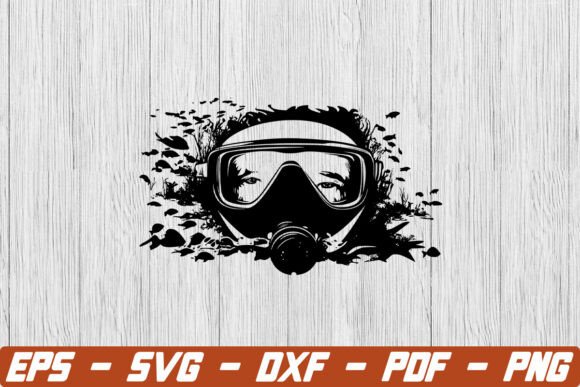
The design itself depicts a scuba diving mask filled with an oceanic scene — coral, fish, light rays, and depth. The level of detail is high enough to feel immersive but clean enough to hold up in production environments. This is not a flat icon. It is a textured, layered illustration that adds visual weight to whatever you place it on.
For creators, this graphic fits at several points in a project lifecycle:
- Before a project — as a source of inspiration or a central theme around which you build a product line.
- During a project — as a core design element you combine with text, borders, or other graphics.
- After a project — as a consistent visual you reuse across multiple product variants or platforms.
Because it comes in vector and raster formats, you are not locked into one workflow. You can start in Illustrator, finish in Photoshop, cut on a Cricut, or send straight to a printer. That flexibility is the reason this type of asset has become a staple for serious makers and small business operators.
Preparation: What to Do Before You Open the File
Before you unzip or import anything, take a few minutes to set yourself up for smooth integration. Preparation eliminates most of the frustration that comes with digital design work.
Check Your Software Compatibility
The five formats cover almost every scenario. But confirm which applications you actually use:
- .SVG — Works in Adobe Illustrator, Inkscape, Cricut Design Space, Silhouette Studio, CorelDRAW, and most web-based editors.
- .EPS — Best for professional vector workflows. Opens in Illustrator, CorelDRAW, Affinity Designer, and similar.
- .PNG — Raster with transparent background. Ready for Photoshop, Canva, Printful, and social media mockups.
- .DXF — Optimized for cutting machines like Cricut and Silhouette when you need vector paths.
- .PDF — Portable, reliable, good for print proofs or client previews.
If you design on an iPad with Affinity Designer or Vectornator, the SVG or EPS will import cleanly. If you produce mockups for Etsy listings, the PNG saves time. Knowing which file does what saves you minutes per project, and those minutes add up.
Organize Your Asset Library
Digital downloads pile up fast. Create a dedicated folder for this graphic and subfolders by format. Name them clearly — for example:
Scuba_Mask_SVGScuba_Mask_EPSScuba_Mask_PNG
Add a metadata note in your design app or a simple spreadsheet with the license terms, resolution, and color mode. This is especially important if you sell products. You want to know at a glance that you have commercial rights and what the original file dimensions are.
Integration: Using the Graphic During Your Workflow
Once you have the file organized, the real work begins. How you integrate this graphic depends on your output — but the pattern is similar across use cases.
For Print-on-Demand and Apparel
Start with the PNG or SVG depending on your mockup generator. If you use Printful, Printify, or a similar platform, the PNG at 300 dpi and 15x18 inches gives you plenty of resolution for most garment sizes. Scale down carefully — if you reduce the image below 50%, sharpness remains, but always preview at actual print size.
For layered designs on dark garments, the PNG transparent background is ideal. You can place the graphic on a white or colored circle base, or let it float on the fabric directly. The ocean scene detail works best on shirts, hoodies, and tote bags where the design can breathe without too many folds or seams.
If you cut heat transfer vinyl (HTV) with a Cricut or Silhouette, use the DXF or SVG. The vector paths are closed and clean, which means your machine cuts accurately the first time. Test a small piece of scrap vinyl before committing to a full sheet — this one step saves material and frustration.
For Home Décor and Wall Art
The 15x18 proportion fits standard frame sizes like 15x18 or 16x20 with slight cropping. Open the EPS or SVG in Illustrator or Inkscape and adjust the canvas size to match your frame. Because the design is vector, you can scale it up to poster size without losing detail.
For multi-panel displays, isolate elements from the ocean scene — the coral cluster, the fish, the light rays — and place them across separate panels. This creates a cohesive set that sells as a bundle. Keep the color palette consistent across panels to maintain a professional look.
If you sell digital wall art on Etsy or Creative Market, export the final design as a high-resolution JPG or PNG at 300 dpi. Include multiple aspect ratios (2:3, 3:4, 4:5) so buyers can use different frame sizes. This small effort dramatically increases listing appeal.
For Scrapbooking, Planners, and Paper Goods
Paper crafters often need graphics that withstand multiple resizing and recoloring. The SVG and EPS are essential here. Import the file into your design software, ungroup elements, and select only the parts you need — a single fish, a piece of coral, the mask outline. Recolor them to match your paper palette.
Because the design is detailed, use it as a focal point on a card or journal page rather than a background pattern. Busy backgrounds tend to overwhelm paper projects. Let the graphic be the hero.
Commercial Use: What You Can and Cannot Do
This graphic comes with both personal and commercial use rights. That is a significant advantage for small business owners and entrepreneurs. You can incorporate the design into physical products and sell them — shirts, mugs, prints, stickers, tote bags, phone cases, and so on. You do not need to pay royalties or credit the designer.
However, there is one clear restriction: you may not resell or redistribute the digital files themselves. Do not package the SVG, EPS, PNG, DXF, or PDF as part of a digital bundle, a design template set, or a clip art collection. The license is for use of the design in your own products, not for passing the raw files to someone else.
This distinction matters for compliance and for maintaining trust in creator marketplaces. If you ever plan to hire a production assistant or outsource part of your workflow, share only the final output files (e.g., the printed product mockup), not the source vectors.
Practical Implementation Tips for Quality Control
Quality control is the difference between a product that sells and one that collects returns or complaints. With a detailed graphic like this, a few checks go a long way.
Verify Resolution Before Printing
Even though the file starts at 300 dpi and 15x18 inches, scaling up beyond 200% in raster software will introduce pixelation. For large prints — posters 24x36 or larger — always use the vector formats (SVG or EPS) so scaling is mathematically clean. If your print shop requires a raster file, export from the vector source at the exact final size.
Check Cut Lines for Vinyl and Heat Transfer
Open the DXF or SVG in your cutting software and examine the preview. Look for small stray nodes or open paths. If the ocean scene contains very thin lines (e.g., light rays or fish fins), increase the cut line thickness slightly in your software or use a weeding tool carefully. Test cuts on scrap material are cheap; wasted blanks are not.
Color Consistency Across Products
The original design has a specific color mood — ocean blues, coral pinks, sandy highlights. When you use the same graphic on a shirt, a mug, and a print, ensure the colors match across production runs. Different substrates absorb ink differently. Request a proof or print a sample before scaling up. Adjust saturation or brightness in your design app if needed.
Long-Term Use: Scalability and Reusability
A well-chosen graphic pays for itself many times over if you plan for reuse. The Scuba Diving Mask with Ocean Scene SVG is not a one-off design. It is a theme you can build around.
- Seasonal variations: Change the background color to match summer, nautical, or tropical collections.
- Product expansion: Apply the same design to different product categories — apparel, drinkware, home décor, accessories.
- Cross-platform consistency: Use the same graphic on your website, social media mockups, product packaging, and printed inserts. Visual consistency builds brand recognition.
- Derivative designs: Extract individual elements (the mask, a fish, the coral) and use them as accent graphics for smaller products like stickers, buttons, or patches.
Because the files are vector, you can modify colors, remove elements, or combine the illustration with other graphics without quality loss. Keep the original files untouched in a master folder, and always work from copies. This habit prevents accidental overwrites and preserves your source material for years.
Observations on Workflow Efficiency
From a process perspective, the value of this graphic lies in its format coverage and commercial license. You do not need to convert, retrace, or relicense. That removes friction at every stage.
If you produce physical goods, the DXF and SVG eliminate the most time-consuming part of the workflow — preparing cut-ready files from scratch. If you sell digital downloads like printable wall art, the high-resolution PNG and PDF mean you can list products within minutes of download. If you run a design service, the EPS gives clients a professional vector file they can edit or hand off to printers.
The 15x18 inch size at 300 dpi is not arbitrary. It fits standard production dimensions for apparel and prints, reducing the need to resize. When you do need other sizes, the vector formats handle scaling without degradation. This is the kind of practical detail that separates assets meant for real production from assets meant only for screen display.
Final Thoughts on Integration
The Scuba Diving Mask with Ocean Scene SVG is more than a pretty image. It is a production-ready asset that fits into a repeatable workflow. Preparation, format selection, test prints, and consistent reuse are the practices that turn a single digital download into a reliable part of your product line. If you treat it as a component in a system — not just a one-off design — it becomes a tool that saves time, reduces waste, and supports growth.
Open the SVG. Run a test cut. Export a mockup. Build a collection. That is how you move from download to done.